

Original Public Domain 3D Benchy (High Resolution)


Original Public Domain 3D Benchy (High Resolution)
- Made to order — 3D printed after you buy
- Free shipping on orders over $25
- Quality checked before it ships
- Questions? Contact us · Returns
Print the world’s most famous 3D printing test boat, now fully in the public domain, and see exactly how dialed in your printer really is.
This model is quick to print and gives immediate, visual feedback on your printer’s tuning status. Ideal for troubleshooting, slicer profile validation, or comparing print quality across different machines or materials.
On 15 February 2025, I uploaded the first official Public Domain version of 3DBenchy to MakerWorld, making it freely available for everyone to print, remix, and share—without restrictions.
The Iconic 3DBenchy Enters the Public Domain
14 February 2025 – 3DBenchy, a 3D model designed specifically for testing and benchmarking 3D printers, is now in the public domain. Originally released on April 9, 2015, by Creative Tools, the model has become a beloved icon of the 3D printing community. Following Creative Tools' acquisition and merger into NTI in 2024, NTI has decided to release 3DBenchy to the world by making it public domain, marking its 10th anniversary with this significant gesture.
What is this about?
The 3D Benchy is a purpose-built calibration model for FDM 3D printers, designed to test a wide range of print parameters in a single, compact object. This model helps identify mechanical inaccuracies, slicer misconfigurations, and hardware limitations through real-world geometric features.
1. Hull Overhang & Surface Finish
- The smooth curvature of the hull tests how well your printer handles large overhangs (~40°) and maintains consistent layer quality across curved surfaces.
- Look for surface ripples—these indicate issues with cooling, extrusion consistency, or mechanical rigidity.
2. Chimney & Cylindrical Precision
- The chimney includes concentric cylinders (inner & outer) that test roundness and concentricity.
- Any slouching or deformation hints at inadequate cooling or low resolution.
3. Overhangs & Bridging Elements
- The roof overhang (~5.5°) and under-bridge areas challenge your printer's ability to bridge and cool without support.
- Signs of drooping in these regions often point to poor fan performance or excessive extrusion temperature.
4. Portholes & Hollow Features
- Large and small circular holes (porthole, hawsepipe) reveal how well your printer bridges and prints enclosed cavities.
- Clean circular edges indicate proper retraction, flow control, and cooling.
5. First-Layer Details & Bed Adhesion
- The embossed "3DBenchy" text on the underside is only ~0.1 mm tall—ideal for testing first-layer squish, leveling, and adhesion.
- Check for "elephant's foot" or gaps between lines in these features.
6. Fine Text & Detail Accuracy
- The minuscule stern lettering (≈2 mm tall) checks precision in extrusion and small-scale definition.
- Blurred or missing letters suggest flow issues or mechanical backlash.
Summary
The 3D Benchy is more than a cute boat—it's a precision diagnostic tool. By inspecting:
- Curved surfaces → diagnose layer consistency.
- Cylinders → check dimensional accuracy.
- Bridges & overhangs → evaluate cooling and slicer settings.
- Holes → test bridging and retraction.
- First-layer embossing → assess leveling and extrusion.
- Fine text → reveal minute missteps in precision.
The Origins of 3DBenchy
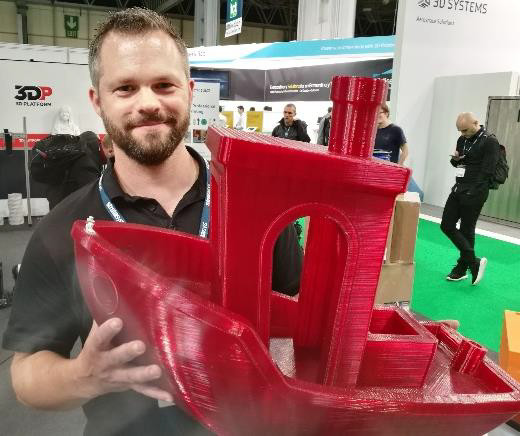
While working at Creative Tools, Daniel Norée designed the boat model as a benchmarking tool for 3D printers. Paulo Kiefe, CEO of Creative Tools until 2018, shared Norée's enthusiasm for 3D printing, named the model “3DBenchy,” and established its online identity by uploading it to 3D printing repositories. Released in 2015 under a Creative Commons: No Derivatives license, the model's design was protected from modifications, ensuring its effectiveness as a calibration tool. The immense popularity of 3DBenchy quickly made the original model widely recognizable. The 3D printing community embraced it wholeheartedly, creating numerous versions despite the licensing restrictions. However, Creative Tools never had to enforce the “No Derivatives” clause, as the community respected 3DBenchy’s original purpose.
Transition to the Public Domain
When Creative Tools was acquired by NTI in 2024, NTI became the custodian of 3DBenchy. As a leading full-service supplier of digital solutions for the construction, design, manufacturing, and media & entertainment industries, NTI had no interest or plans to monetize the use of 3DBenchy. In January 2025, rumors surfaced that remixes of 3DBenchy were being removed from Printables due to the enforcement of the original license. However, NTI did not initiate this action. Prusa Research, the company behind Printables, later confirmed that a third-party report - not NTI - prompted the enforcement. NTI clarified it had not sought to remove downloads or derivatives of the model and had taken no legal action in this regard. This incident highlighted the enduring importance of 3DBenchy within the 3D printing community. Recognizing its cultural significance, NTI, Daniel Norée, and Paulo Kiefe collaborated to decide on transitioning 3DBenchy to the public domain, ensuring it remains accessible and remixable for everyone.
Passing the Torch
With this licensing change and to preserve the open-source legacy of 3DBenchy, the website www.3dbenchy.com and associated social media accounts will be entrusted to Paulo Kiefe and Daniel Norée. The only stipulation for this transition is that 3DBenchy remains publicly available to all.
A Celebration to Remember
Mark your calendars for April 9, 2025, as 3DBenchy celebrates its 10th anniversary! A special surprise is planned for the 3DBenchy community to commemorate this milestone. Stay tuned for exciting updates and downloads on www.3dbenchy.com.
Design by Professional3D on MakerWorld (license: CC0).